



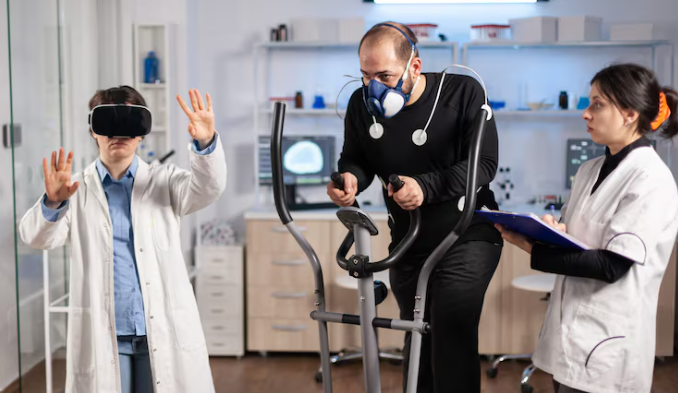
A nurse in a busy London emergency room swiftly navigates a screen that resembles any other hospital dashboard. However, the software that powers it is quietly predicting which patients are most likely to worsen within the next hour. No drama, no alarms. Just real-time shifting probabilities. The subtlety of the change and its potential significance are difficult to ignore.
In ways that seem more like a gradual rewrite than a revolution, artificial intelligence has been infiltrating the healthcare industry. Stethoscopes still hang from the necks of doctors, but systems capable of processing thousands of variables at once are increasingly influencing the decisions that surround them. This change may eventually seem as commonplace as electronic records do now. However, there is still a little tension in the air at the moment.
| Category | Details |
|---|---|
| Technology | Artificial Intelligence (AI) |
| Industry | Global Healthcare |
| Key Use Cases | Diagnosis, drug discovery, patient monitoring, admin automation |
| Major Players | Tech firms, hospitals, pharma companies |
| Market Growth | Expected to reach ~$187 billion by 2030 |
| Key Benefit | Faster diagnosis, personalized treatment |
| Key Challenge | Trust, bias, integration issues |
| Global Impact | Could help 4.5 billion people lacking healthcare access |
| Notable Trend | Predictive and preventive medicine |
| Reference | World Economic Forum – AI in Healthcare |
The most obvious effect manifests itself in diagnosis. AI systems are now able to identify tumors and fractures with a degree of accuracy that occasionally outperforms human specialists thanks to training on enormous collections of medical images. In one study, software that analyzes brain scans was able to identify not only whether a stroke was present but also when it most likely started.
This information can determine whether a patient gets life-saving care. There is a mixture of relief and reluctance when observing how clinicians use these tools. Accuracy increases. However, reliance increases.
The ramifications go beyond hospitals, as most people are unaware. Approximately 4.5 billion people worldwide still do not have access to basic medical care. Theoretically, AI could provide medical knowledge in areas with a shortage of physicians, such as remote villages, rural clinics, and even patient smartphones. There is a feeling that technology could reduce distance and make knowledge more accessible to people who have never had it. It’s still unclear if infrastructure and trust will follow.
The lengthy and costly process of developing new drugs is also starting to change. Before a single physical test is conducted, AI models are able to sort through chemical compounds and predict which ones might be successful. Pharmaceutical companies are paying attention and investing billions in systems that promise quicker cycles of discovery. Investors appear to think that this could significantly alter timelines. However, early promise doesn’t always translate into practical treatments, and drug development has a way of dampening optimism.
Some of the most noticeable changes in hospitals are less glamorous. Quietly, administrative tasks like scheduling, billing, and documentation are being automated. AI systems that transcribe conversations and organize records in real time are beginning to replace doctors who used to spend hours typing notes after long shifts. It sounds insignificant. It isn’t. Although it’s still unclear if hospitals will use those gains to improve care or just reduce costs, lessening that burden could alter how much time doctors actually spend with patients.
Additionally, a more profound but less obvious change is taking place. Healthcare is transitioning from reactive to predictive thanks to AI. By examining patterns in genetics, lifestyle, and medical history, systems are starting to detect disease risks years before symptoms manifest. It’s possible that medicine will focus more on preventing disease than on treating it. That concept has existed for many years. It feels closer now, but it’s still out of reach.
However, the issues are not insignificant. Healthcare data is frequently incomplete, biased, or messy, and AI systems are only as good as the data they are trained on. These tools run the serious risk of perpetuating current disparities by providing more accurate forecasts for certain populations than others. Physicians are aware of this. Patients are starting to notice it. Once lost, trust is hard to regain.
Additionally, there is the issue of accountability. Who is responsible when an AI system makes a diagnosis that turns out to be incorrect? The physician? The medical facility? The creator? Regulators are finding it difficult to keep up with the rapid advancement of technology, and there are currently no clear answers to these questions.
As this develops, it seems as though healthcare is at a precarious crossroads. It wasn’t exactly changed, but it wasn’t the same. Expectations are growing, the data is growing, and the tools are getting better. Nevertheless, the human element—imperfect, emotional, and uncertain—remains at the core.
Whether AI will fulfill its potential or settle for something less ambitious is still up in the air. However, the change is already taking place in emergency rooms, labs, and clinics. Silently. gradually. And maybe deeper than it seems at first.
