



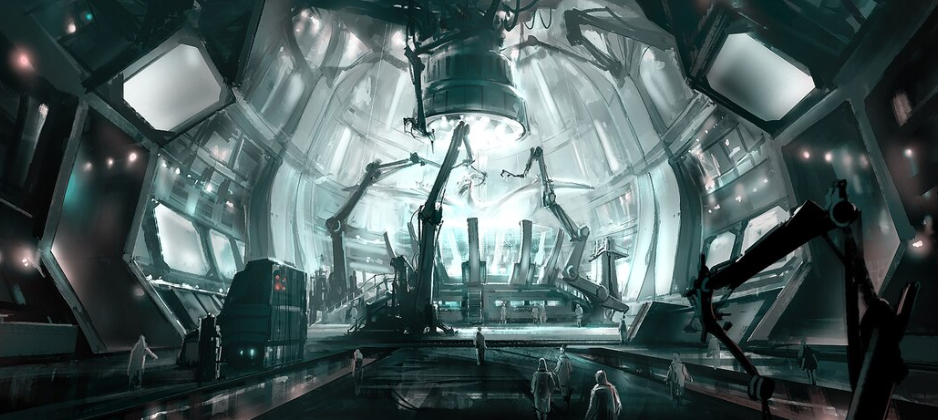
The elevator ride takes ten minutes or so. It descends through the Homestake Gold Mine, which was tunneled, blasted, and carved out of South Dakota’s Black Hills until the gold ran out. The mine operated for a century before it closed. Instead of dropping miners, the cage now drops scientists, and when it stops about a mile and a half below the surface, the walls are close together and the air is cool.
The smell of old rock is subtle. Industrial lighting is used. The netting used by the miners to line the tunnels is still present in some places, but it now flanks a corridor that leads into one of the most bizarre workplaces in modern science after a short walk, a helmet exchange, and a double layer of booties over steel-toed boots.
| Detail | Information |
|---|---|
| Primary Lab | Sanford Underground Research Facility (SURF) — Lead, South Dakota; housed in a former Homestake Gold Mine, approximately 1.5 km (nearly 1 mile) underground |
| Current Experiment | LUX-ZEPLIN (LZ) — successor to the Large Underground Xenon (LUX) experiment; 70× more sensitive than original LUX; cost approximately $60 million; began operations 2022 |
| Previous Experiment | LUX (Large Underground Xenon) — cost $10 million; ran 2013–2016; final sensitivity 4× better than original project goals; found no dark matter |
| Detection Method | 302 kg of ultra-cold liquid xenon in a titanium cryostat; suspended in 272,500 litres of purified water; seeks faint flash of light + electrical charge when a dark matter particle strikes a xenon nucleus |
| Target Particle | WIMPs — Weakly Interacting Massive Particles; still the leading theoretical candidate for dark matter |
| What Dark Matter Is | Estimated to make up ~80–85% of all matter in the universe; detectable only through gravitational effects; holds galaxies together; without it, galaxies would “quickly fly apart” |
| What Dark Matter Is Not | Not visible light; not detectable by standard electromagnetic instruments; passes through ordinary matter almost entirely without interaction |
| Scale of Passage | Hundreds of millions of dark matter particles pass through Earth every second — but interact so weakly that none have been directly detected |
| Key Scientist | Richard Gaitskell, Brown University — co-spokesman for LUX; 28+ years hunting dark matter particles |
| Rival Experiment | XENON experiment — Gran Sasso Laboratory, Italy (underground, Apennine Mountains); results also negative as of 2024 |
| Latest LZ Result (2024–2025) | Most sensitive dark matter search in history; found no WIMP signal; results consistent with background noise alone |
| Reference | sanfordlab.org — Sanford Underground Research Facility |
The LUX-ZEPLIN experiment is located inside, surrounded by the planet’s most meticulously purified materials. It is a detector that holds 302 kilograms of liquid xenon in a titanium cryostat suspended in 272,500 liters of purified water. It is buried beneath a mile of rock, specifically to block cosmic rays and ambient radiation that would drown out any signal the scientists are hoping to find. It is estimated that hundreds of millions of dark matter particles flow through this apparatus every second. Not a single one has made an announcement as of the most recent results, which were released in 2024 and 2025.
Failure, if that’s even the right word, isn’t due to a lack of effort or accuracy. LZ’s predecessor on this site, the original LUX experiment, completed its last run in 2016 with sensitivity four times higher than its initial engineering objectives. Nothing in line with dark matter was discovered.
That is seventy times less sensitive than LZ. It represents decades of accumulated experience in particle detection, xenon purification, and protecting experimental chambers from interference so subtle that it is difficult for the average person to understand. It is the most capable device ever constructed for this particular purpose.
Additionally, its outcomes are consistent with background noise alone. In the LUX findings, Rick Gaitskell of Brown University stated that “what we have observed is consistent with background alone.” The particle physicists describe this with a cautious neutrality that takes time to fully land.
For twenty-eight years, Gaitskell has been searching for dark matter particles. The reasoning behind his perseverance is not nuanced. Over 80% of the universe’s matter is dark matter. The visible stars, gas, and dust don’t provide nearly enough mass to explain why galaxies hold together without it, making the gravitational accounting of galaxies impossible. In the words of one of the LZ researchers, galaxies would be “quickly flying apart” if there were nothing invisible.
Without something enormous that no one can see, touch, or measure directly, the universe as it exists, with its clusters and filaments and the large-scale structure astronomers spend careers mapping, cannot be explained. “You and I are the flotsam and jetsam,” Gaitskell once remarked. “Dark matter is the sea.” It’s accurate and one of the more striking ways to describe a scientific situation.
Weakly interacting massive particles (WIMPs), a class of hypothetical particles that would interact with ordinary matter only through gravity and the weak nuclear force, continue to be the most promising explanation for what dark matter is. Just enough to theoretically cause a sporadic collision with a xenon nucleus that could be detected by what the LZ team refers to as the time projection chamber as a faint flash of light in a sufficiently sensitive detector.
The xenon was specifically chosen because it allows physicists to differentiate between a collision with a nucleus, which is what a WIMP would do, and a collision with an electron, which would indicate normal background radiation. As these things go, the detection chain is sophisticated. It hasn’t received the signal it has been waiting for.
The more open-minded physicists will carefully consider the possibility that WIMPs do not exist in the form predicted by the theory. Not insurmountable. After decades of institutional investment in the theory, it’s just awkward to say out loud. The XENON project, a competing international team’s experiment conducted deep beneath the Gran Sasso mountain range in central Italy, has yielded the same outcome: nothing.
The International Space Station has its own equipment for detecting dark matter. WIMPs from high-energy collisions have been sought after by CERN’s Large Hadron Collider. It is getting harder to blame insufficient sensitivity alone for the lack of a signal that accumulates over several independent experiments using various techniques and locations.
And yet. Dark matter still makes up the majority of the universe. That is still the same. With each unfavorable outcome, the range of potential masses and interaction strengths where WIMPs can conceal themselves has narrowed. Every empty-handed run is a constraint in its own right; it’s a section of parameter space that has been ruled out, a door that is closed on some possibilities but left open on others.
As you watch scientists explain these findings, you get the impression that they are simultaneously carrying two burdens: the quiet weight of a search that keeps failing to find what it’s looking for and sincere pride in instruments that perform beyond their design specifications. Neither emotion negates the other.
If WIMPs fail, it’s still unclear what will happen next. One option is axions. Another is sterile neutrinos. Some theorists are investigating the possibility that dark matter is not a particle at all in the traditional sense. These alternatives are being discussed more candidly in the field than they were ten years ago, which is either a sign of healthy scientific pluralism or an admission that the prevailing framework needs to be reevaluated.
Maybe both. The South Dakota mine will continue to operate. The xenon will remain chilled. The solution must exist somewhere in the darkness that encompasses most things, just waiting to be discovered by an instrument that is sensitive enough or imaginative enough.
