



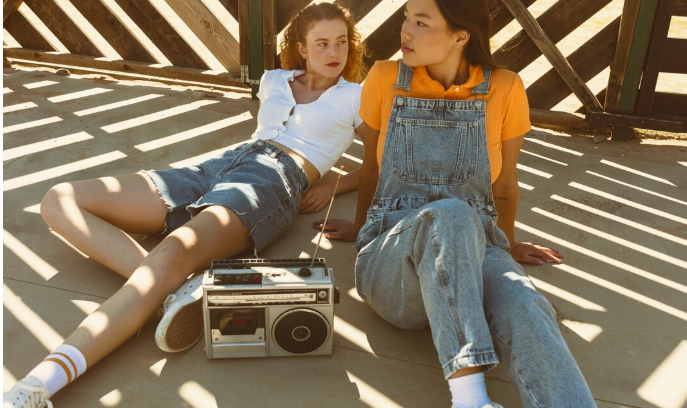
This spring, you can witness the same thing taking place in any thrift store in East London, Brooklyn, or Karachi. With a sort of focused intensity, teenage girls flipped through racks of denim, pulling out cropped polos, wide-leg jeans with frayed hems, and the occasional belt adorned with rhinestones that someone had obviously purchased at a mall in 2003. The items are not being used as costumes. For feeds that haven’t really stopped feeding the same loop for nearly three years, they are being styled, layered, and photographed.
According to most forecasts, Y2K fashion ought to have peaked and quietly faded by now. It hasn’t. If anything, 2026 has proven to be its most boisterous year to date, and that’s something to take note of. Typically, trends have a shorter cycle. Something becomes popular, takes center stage for a season or two, and then is quietly put away in the closet. This one won’t go away.
| Topic Snapshot | Details |
|---|---|
| Trend Name | Y2K Fashion Revival |
| Origin Era | Late 1990s – Early 2000s |
| Comeback Year | 2020, gaining real momentum by 2023 |
| Peak Cultural Moment | 2026 |
| Core Aesthetic | Maximalist, playful, futuristic, slightly chaotic |
| Signature Pieces | Low-rise jeans, baby tees, cargo pants, velour tracksuits, platform sneakers, tiny shoulder bags |
| Driving Platforms | TikTok, Instagram, Pinterest |
| Key Demographic | Gen Z, younger Millennials |
| Cultural Touchstones | Mean Girls, The Princess Diaries, Gilmore Girls, early Britney, J.Lo |
| Sustainability Angle | Heavy thrifting and resale culture |
| Counter-Trend It Replaced | Quiet luxury, Scandinavian minimalism |
| Forecast | Expected to coexist with newer aesthetics rather than fade |
There’s no point in pretending otherwise because part of it is algorithmic. Since about 2022, TikTok’s For You page has been promoting low-rise everything. It used to take fashion magazines six months to validate a viral video, but now it only takes about forty seconds. However, algorithms by themselves cannot account for the look’s enduring popularity. A sixteen-year-old in 2026 is drawn to a baby t-shirt that her mother most likely had while attending college for a reason that goes beyond the algorithm’s recommendation.
Speaking with younger customers gives the impression that they’re worn out. I’m sick of the beige. I’m sick of seeing capsule wardrobes that resemble those of everyone else. With all those camel coats and unbranded cashmere sweaters designed to whisper rather than shout, quiet luxury had its run. Eventually, though, the whispering became oppressive. Y2K is the reverse of that. It’s loud, a little tacky, sometimes ugly, and totally unconcerned with looking pricey. That’s the allure.
Strangely enough, it’s also a form of permission. The maximalist style of the early 2000s—denim over denim, three belts at once, a tank top layered over a long-sleeved shirt for no apparent reason—feels almost unfamiliar today. Instead of dressing for curated grids or resale value, people dressed for fun. It’s fascinating to watch teenagers in 2026 recreate that energy because the majority of them weren’t even alive during the initial wave. They are using old paparazzi pictures of Paris Hilton leaving a Beverly Hills boutique with a small dog under one arm, as well as movies and music videos.
Even though it’s frequently oversold, the sustainability component is important. Y2K pieces are simple to remix, resize, and thrift. A 2002 pair of low-rise jeans still looks good. One could argue that a denim jacket with studs from the same era looks better today than it did back then. Secondhand Y2K strikes a helpful sweet spot for a generation that has been constantly informed that fast fashion is destroying the environment because it is expressive, reasonably priced, and at least somewhat guilt-free.
It’s genuinely unclear if the trend will continue through 2027. It will eventually be replaced by something else because fashion is cyclical. However, the cargo pants are still being cuffed, the butterfly clips are still selling out, and the mini bags are still too small to contain anything practical. Perhaps that’s the main idea.
