



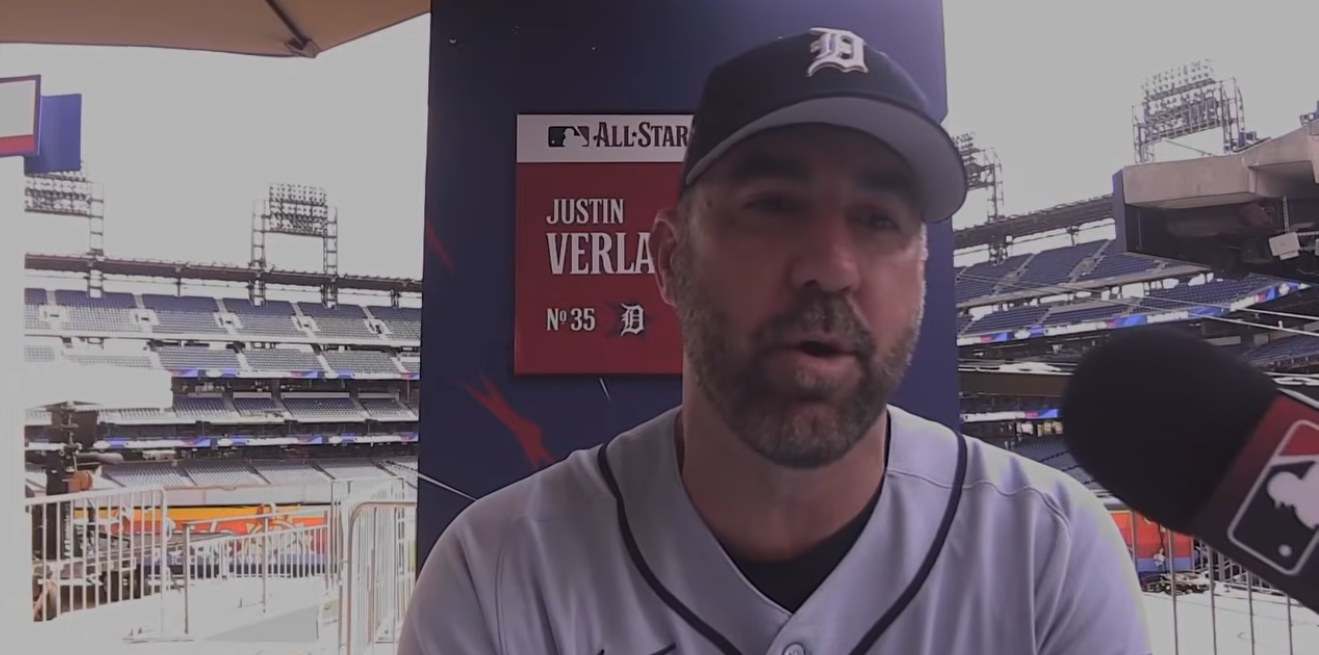
A certain type of athlete changes the way you think about what it means to live a long time. That player is Justin Verlander. He is now 43 years old and has signed a one-year, $13 million deal to pitch for the Detroit Tigers, the team that picked him second overall in the 2004 draft. This is the end of a career that keeps finding new chapters. Behind it all is a net worth of about $200 million, which was built up over 20 years of great work, smart contracts, and a body that wouldn’t quit.
Take a moment to think about that number. Two hundred million dollars for a pitcher. In a sport where quarterbacks and point guards make most of the money, Verlander made a lot of money through speed, durability, and the kind of postseason calm that teams pay crazy amounts of money to get.
His first contracts were pretty standard. Years before arbitration, low pay, and the normal quiet rise of a young star proving himself game by game. But things took a big turn when Detroit signed him to a seven-year, $180 million deal in 2013. It was the richest deal ever given to a pitcher. You could feel how heavy that moment was when you were outside of Comerica Park that winter. Detroit was putting all of its eggs in one arm from Michigan. It felt right, even though the Tigers never quite put together a team that could win the championship.
Things were different after the trade with Houston in 2017. Verlander was sent to the Astros right before the trade deadline. In his first five starts, he didn’t lose a game. That fall, he helped win the World Series, was named the ALCS MVP, and pretty much regained his earning power at a time when most pitchers are slowly retiring. The Astros signed him to a new deal in 2019 that was worth an average of $33 million a year. In response, he threw his third no-hitter and had his first season with 300 strikeouts. That is not an arc of decline. That is a second prime.
Even more was added to the deal by the Mets in December 2022: two years, $86.6 million, which was tied for the highest annual salary ever paid to a pitcher at just over $43 million per season. It still shocks me a little to think about. That much money for a pitcher who is getting close to 40 and just had Tommy John surgery. Instead of the Mets being desperate, it’s because Verlander is one of the few pitchers who can do what he does, and teams know it.
When all of his on-field earnings are added up at the end of the 2026 season, they will likely be more than $409 million, making him second all-time in MLB history, only behind Alex Rodriguez. A 6-foot-5 right-hander from Manakin Sabot, Virginia, who once threw 84 mph at a youth academy in Richmond shouldn’t be talking about that kind of number. That kind of number is usually for outfielders and sluggers.
The financial story is linked to the pitching story in a way that is easy to miss. Verlander never played for money more than he wanted to win. He did very well when he went to Houston, which wasn’t the biggest market or the most exciting place to visit. He came back to Detroit at age 43 on $13 million, a small fraction of what he used to make. He seemed more interested in finishing what he started than in getting one last paycheck.
Watching this last season, I get the impression that the money was never the main goal, but just a nice bonus. It has more than 3,550 strikeouts, 266 wins, and three Cy Young Awards. That’s the real ledger. The net worth of $200 million is what long-term, top-notch work looks like when you also take care of your career.
