



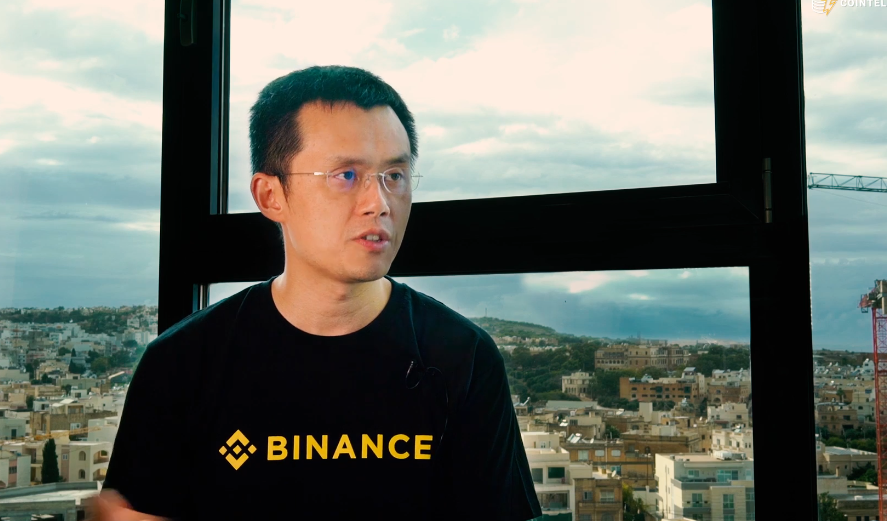
When you sit with Changpeng Zhao’s story long enough, it almost seems disorienting. In Vancouver, a teenager helps his immigrant family pay their rent by working as a burger flipper. A quiet computer science student at McGill. A Tokyo-based developer creates trading software. And now one of the world’s twenty richest people, depending on which list you believe. The figures, which Forbes estimates to be between $107 and $111 billion, are so astounding that they almost seem unreal.
Zhao, better known as CZ, built his fortune almost entirely through Binance, the cryptocurrency exchange he co-founded in 2017. He still owns a substantial amount of BNB tokens, Binance’s own utility coin, and an estimated 90% of the business. Binance is currently valued at roughly $100 billion and reportedly processed over $30 trillion in trading volume across 2024 and 2025, capturing around 38% of global crypto trading. That kind of market position doesn’t come from luck. It comes from an early, aggressive bet — and a willingness to move faster than regulators could follow.
That final section turned into a major issue. As part of a settlement with US authorities, CZ left his position as CEO of Binance in November 2023. He accepted a four-month federal prison sentence, paid a $50 million personal fine, and entered a guilty plea to violating the Bank Secrecy Act. Binance paid $4.3 billion in fines on its own. He was released in late September 2024 after serving his time at the Federal Correctional Institution in Lompoc, California. By all accounts, it was a huge setback for the founder of the biggest cryptocurrency exchange in the world. And yet.

Donald Trump granted Zhao a full presidential pardon on October 23, 2025, just over a year after he was freed. It’s important to understand the history of that pardon. According to the Wall Street Journal, Binance was secretly managing a trading platform for Trump’s World Liberty Financial and had discussed business matters with Trump’s family. Additionally, Binance had invested $800,000 in clemency-related lobbying. Although the White House presented the pardon as ending what it described as the Biden administration’s “war on cryptocurrency,” it is challenging to look at those facts and come to a straightforward conclusion. Depending on your current position, you may or may not find that explanation satisfactory.
The wealth itself is more difficult to dispute, though CZ makes an effort. He reacted bluntly on X when Forbes estimated his net worth at $110 billion in March 2026, calling the figure “not accurate” and characterizing rich lists as basically conjecture. He cited the fact that the markets for Bitcoin and other cryptocurrencies were still about 50% below their peak. In one way, it’s true that it can be challenging to determine the precise nature of crypto-linked fortunes. However, it’s also a little out of the ordinary to hear one of the richest people in the world objecting—not out of modesty, but rather out of dissatisfaction with the process.
Zhao’s wealth actually illustrates the extent to which cryptocurrency infrastructure has grown. This isn’t speculative coin-flipping wealth. An estimated $16 to $17 billion is made by Binance each year. Regardless of its legal background, that is a legitimate business. Giancarlo Devasini, a co-founder of Tether, is ranked 22nd globally with an estimated net worth of $89 billion. A few years ago, the idea of crypto entrepreneurs sitting comfortably above old-guard industrialists on global wealth rankings would have felt premature.
CZ was born in Jiangsu province, China, to a family of schoolteachers. After CZ was born, his father was called a “pro-bourgeois intellect” and temporarily banished. The family eventually emigrated to Canada after the Tiananmen Square events in 1989. There’s a certain stubborn resilience running through that background, and it’s hard not to see it reflected in the arc of his career — the overnight gas station shifts, the apartment he sold in Shanghai to go all-in on Bitcoin in 2013, the company he built into the world’s dominant exchange, and the prison sentence he absorbed without, it seems, much visible damage to the enterprise.
Whether Changpeng Zhao’s net worth is $107 billion, $111 billion, or something else entirely, the fundamental truth is that he built the infrastructure that drives a significant amount of global cryptocurrency trading, made the largest wager of his life on a technology that most people considered to be fringe speculation, and survived situations that would have ended most careers both financially and legally. It’s not a fairy tale. Somehow, that’s just what took place.
