



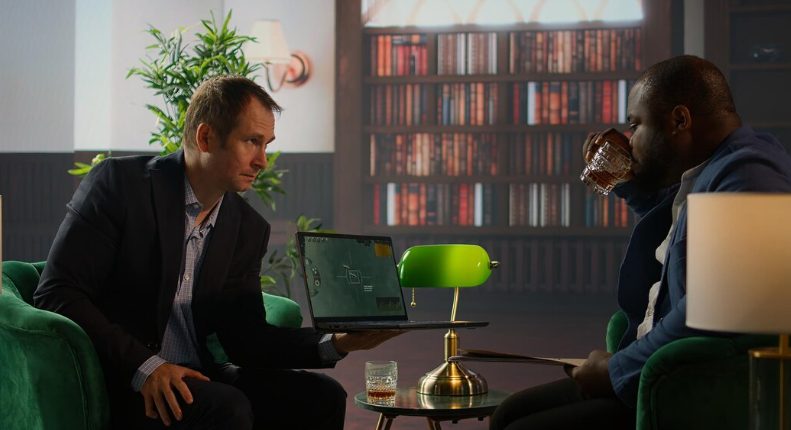
The courtroom itself appeared unremarkable. Decades of use have polished the oak benches. High behind the bench was an American seal. While they wait for the start of the proceedings, lawyers flip through thick binders. However, in the judge’s chambers just down the hall, something strange was taking place.
Rather than piles of paper briefs on desks, lines of text generated in a matter of seconds flickered on a computer screen. Depositions, testimony, witness statements—thousands of pages—being distilled into summaries almost instantly. The judge presiding over the case made the decision to test a concept that, until recently, seemed like science fiction: allowing artificial intelligence to draft portions of the court’s legal work.
| Category | Details |
|---|---|
| Institution | United States Federal Judiciary |
| Technology | Generative AI legal research and document analysis |
| Key Tools | AI summarization systems, document search platforms, legal LLMs |
| Major Use Case | Automating review and summarization of thousands of pages of testimony |
| Typical Case Volume | Trials can include 5,000+ pages of transcripts and hundreds of exhibits |
| Legal Debate | Bias, accuracy, accountability in AI-assisted judgments |
| Academic Discussion | Cambridge University Press research on AI in judicial systems |
| Reference | https://judicature.duke.edu |
The announcement wasn’t dramatic. No press conference. Just a low-key experiment taking place within the Federal Judiciary of the United States.
The case itself was extensive. Numerous witnesses. Almost a thousand exhibits. Trial transcripts total about 5,000 pages. Anyone familiar with federal litigation is aware of the routine: clerks spend late nights reading testimony, underlining key points, and creating summaries that ultimately influence the court’s written ruling.
In order to use a specialized AI system for e-discovery, the chambers uploaded all of the case record, including documents, testimony, and court filings. The system could search all documents at once in a matter of seconds. When you asked a question regarding a particular witness statement, the pertinent passages came to light right away. Request a synopsis of a convoluted voting process that was explained in testimony, and the result was a well-written paragraph with citations.
It was a startling contrast. Twenty pages of deposition testimony could take an hour for a junior clerk to summarize. In a matter of seconds, the machine produced a draft summary. quicker than leafing through a binder. quicker than going through a PDF.
However, judgment and speed are not the same thing. And that’s where the complexity arises.
The legal profession has spent centuries developing processes meant to purposefully slow things down, making sure arguments are examined, evidence is verified, and reasoning is examined. In contrast, acceleration is what artificial intelligence thrives on. It creates believable text at startling speed, predicts words, and puts patterns together.
One of the judiciary’s silent problems, information overload, might be lessened by technology. Massive amounts of digital evidence are frequently used in contemporary federal cases. Emails. spreadsheets. financial records. surveillance video. Just navigating the documents can take months for a judge and a few clerks.
The software did not make a decision in the chamber experiment. The final decision was not written by it either. Rather, it produced working drafts—brief explanations of intricate factual disputes, summaries of testimony, and outlines of legal arguments. The human staff continued to thoroughly examine everything, checking the record and confirming citations.
In many technological revolutions, a profession comes to the realization that its tools are evolving more quickly than its customs. Law, who is renowned for being conservative on such matters, might be getting close to that point right now. Already, case law analysis, evidence summaries, and argument drafting can be done with unsettling fluency by generative AI systems.
Similar tools are emerging in litigation software and research platforms across courts and law firms. AI is being used by lawyers more and more to examine discovery documents and scan contracts. Judges are beginning to test it in small ways—never for final decisions, but often for the tedious groundwork that surrounds them. Still, there is a lot of skepticism.
Legal experts caution that AI systems occasionally misinterpret context or create fake citations. Some are concerned about bias present in training data. Because courts rely so heavily on precedent and trust, the introduction of algorithms creates unsettling concerns about accountability and transparency.
Strict guidelines restricting the use of AI by attorneys in filings have already been issued by some judges. Some demand that lawyers attest that each AI-generated citation has been manually reviewed. As this develops, there’s less enthusiasm for technology and more cautious experimentation.
The software transformed into something akin to an exceptionally quick research assistant inside the judge’s chambers where the brief-writing experiment was conducted. beneficial. Sometimes impressive. Sometimes incorrect. The type of instrument that still needs close supervision. And maybe that’s the point.
The preparation of legal work, such as document sorting, summary writing, and argument organization, may be altered by artificial intelligence, but the final decision-making process is still resolutely human. Law is shaped by centuries of precedent and includes interpretation, context, and moral reasoning in addition to logic.
Still, something has clearly shifted. The legal profession has started experimenting with an odd new partner somewhere between the glowing monitors in chambers and the wooden benches of the courtroom. A quiet one. never-ending. Quick.
It’s unclear if it becomes essential or if it’s just another fleeting experiment. However, it seems like the start of a lengthy discussion about how justice should operate in a time when machines can write nearly as quickly as attorneys can think.
