



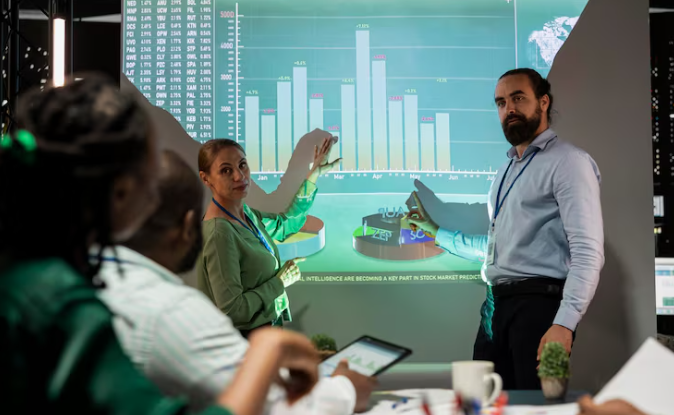
On a foggy morning in San Francisco’s South Park neighborhood, a small cluster of venture capital offices sits quietly behind glass doors and polished steel signage. The scene doesn’t appear dramatic at all. A few founders show up early, practicing pitch decks in local cafés with laptops in their arms. However, billions of dollars move surprisingly quickly inside those offices, supporting the artificial intelligence startups that could shape technology in the coming ten years.
The speed at which the center of gravity has changed is hard to ignore. Venture capital funds were dispersed throughout dozens of tech categories just a few years ago. The flow now appears to be almost compulsive. More than half of all venture capital investments worldwide have recently gone to artificial intelligence companies alone, with over $270 billion in funding. Although no one is certain where it will end, investors appear to be certain that something fundamental is happening.
| Category | Details |
|---|---|
| Industry | Venture Capital / Artificial Intelligence |
| Key Firms | Sequoia Capital, Andreessen Horowitz (a16z), Lightspeed Venture Partners, Accel, General Catalyst |
| Global AI VC Investment | Over $270 billion in 2026 |
| Share of Total VC Funding | Approximately 52% of global venture funding |
| Notable AI Startups Backed | Anthropic, xAI, Mistral, OpenAI ecosystem startups |
| Major Fundraising Example | Lightspeed Venture Partners raised $9 billion for AI investments |
| Headquarters of Major VC Activity | Silicon Valley, San Francisco |
| Reference | Quit Capital |
The companies behind a large portion of this activity resemble a well-known guest list from Silicon Valley. AI funding announcements frequently feature Sequoia Capital, Andreessen Horowitz, Lightspeed Venture Partners, and General Catalyst. As partners talk about the next “foundation model,” the next data platform, and the next AI infrastructure layer, there is a sense of urgency—almost impatience—when you walk through venture offices these days.
Perhaps the best illustration of the scale involved is provided by Lightspeed. Recently, the company raised over $9 billion, mostly for investments in artificial intelligence. Back in 2022, partners reportedly discussed the implications of ChatGPT in quiet conference rooms with views of San Francisco’s streets. Some people have clear memories of the event. It was later described by one investor as the realization that the software industry as a whole had changed.
That conviction is now reflected in the numbers. With significant investments in startups like Anthropic and the French AI developer Mistral, Lightspeed alone has supported over 160 AI businesses. Investors discuss these businesses in the same way that early venture capitalists used to discuss Google or Amazon. Their voices are filled with both excitement and a hint of caution. AI startups spend a lot of money developing data centers and models. Profit frequently seems far off, at least for the time being.
Andreessen Horowitz, also known as a16z, has been just as combative across the valley. A large portion of the more than $7 billion in new capital raised by the company was specifically targeted at artificial intelligence. When one visits their offices, diagrams of infrastructure stacks and model architectures are displayed on whiteboards. It appears more like a research lab than a finance company.
Venture partners are beginning to feel that AI startups need a different kind of support. It’s possible that the old venture model—small initial bets and patient scaling—is no longer viable. It can cost hundreds of millions of dollars to train a large AI model. Investors now have to raise more money, write bigger checks, and act more quickly than they used to because of this reality.
It’s difficult to avoid seeing reminders of past tech booms as this develops. the late 1990s internet craze. The early 2010s saw a boom in mobile startups. However, there is something different about the AI rush—it seems more concentrated, capital-intensive, and possibly even more fragile. Few investors appear willing to slow down, but some openly acknowledge that they are concerned about a bubble forming.
Pioneer Fund and Accel have adopted somewhat different strategies. Rather than concentrating solely on large AI labs, they have started investing in smaller startups that are developing tools related to the technology, such as industry-specific models, AI copilots, and workflow automation. The idea is straightforward: thousands of smaller companies may develop around the foundational AI companies, even if only a small number of them survive.
However, there is still uncertainty. A Chinese startup named DeepSeek shocked the industry earlier this year by developing a potent AI model for a much lower price than anticipated. Investors in Silicon Valley were shaken by the news. The entire funding equation may shift if sophisticated models can be produced at a low cost. Large bets are the lifeblood of venture capital, but they rely on scarcity.
Nevertheless, the momentum persists. When visiting startup demo days in Palo Alto or San Francisco, almost all of the founders appear to be working on artificial intelligence-related projects. Some concepts seem really good. Others are feeling… hopeful. Investors pay close attention, sometimes bending forward in search of the one signal that distinguishes a promising experiment from a future behemoth.
The entire ecosystem is surrounded by an odd atmosphere. A little thrill. tension in part. The next technological frontier has always been the focus of venture capital, but this time seems particularly constrained, as if the sector feels that the window for investment is closing.
It’s unclear if that instinct turns out to be correct. AI could produce companies as influential as Microsoft or Google. Alternatively, the weight of computing costs could cause the economics to collapse. Both options linger in the background.
However, the money continues to flow for the time being. Additionally, partners in Silicon Valley’s quiet venture offices keep looking through pitch decks because they are certain that one of them will be the next big thing to transform the tech sector.
