



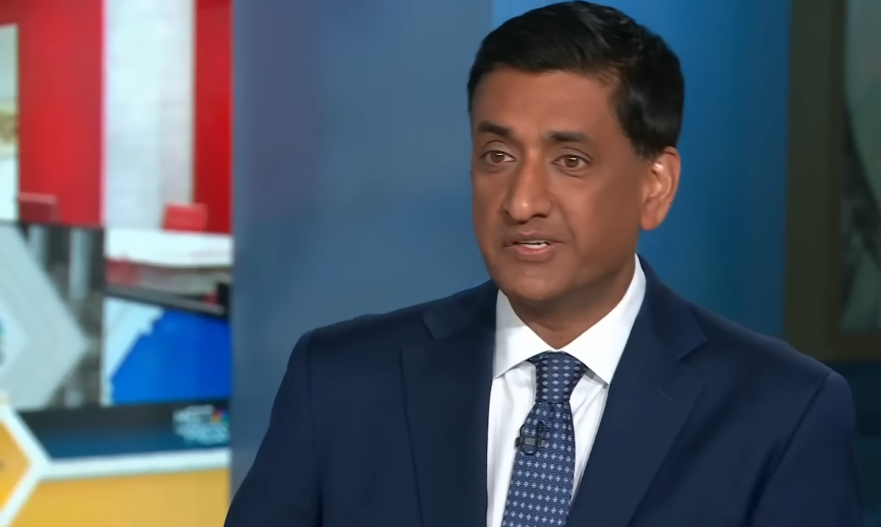
When Ro Khanna talks about wealth inequality, there is something quietly striking about it. This California congressman talks about the “new Gilded Age,” tech billionaires getting too much power, and kids not having enough food because the rich don’t pay their fair share. He does this with a sense of urgency. He sometimes sounds like someone who has grown tired of the game from the outside.
But Ro Khanna is really on the inside. A new report from the Washington Free Beacon says Khanna’s net worth might be more than $340 million. Every word he says at a podium is changed by that number.
A lot of that money didn’t come from laws or working as a lawyer for a long time. The Khanna got married into it. Monte Ahuja started Transtar Industries, a company in Cleveland that sells auto parts. His wife, Ritu Khanna, is the daughter of Monte Ahuja. A private investment firm called Mura Holdings is also run by the Ahuja family. Khanna joined Congress in 2017, and federal records showed that he had a minimum net worth of about $27 million. His wife owned more than 99% of the reported assets. Since then, the number has grown by a lot.
It’s possible that Khanna doesn’t think about the contradiction very much. A lot of wealthy politicians have fought for progressive causes without seeming to mind. FDR was a gentleman. The Kennedy family was one of the wealthiest in American history. This has been done for a long time. What’s harder to ignore, though, are the specifics of Khanna’s life.
The family’s main home in Washington, D.C., is an 8,000-square-foot, about $6 million home with marble floors and an elevator that goes up four stories. It is said that they are moving into a nearby home that is bigger and costs more. Khanna’s two children, who are both still minors, own shares in three private golf clubs and a big part of a $65 billion wealth management firm. The Range Rover his wife drives costs $190,000. She reportedly wasn’t happy with it so much that she sued the dealership over it. These are not the small things that make up a simple life.
Khanna and Senator Bernie Sanders have both co-sponsored the Make Billionaires Pay Their Fair Share Act. This bill would put a 5% annual wealth tax on American billionaires. Khanna was publicly challenged by billionaire David Friedberg to give some of his own money away as a way to show others how to do it. The offer didn’t seem to get much attention. In a letter from June 2026, Grover Norquist made a similar point and asked Khanna to pay a wealth tax on his own as a matter of principle.
After months of seeing this happen, it seems like Khanna’s critics are more interested in the show than in his politics. The house, the elevator, and the golf clubs. It makes it easy to hit. But the question itself isn’t completely unfair. Can someone really lead a discussion about reducing wealth if they live in trusts, anonymous corporations, and foundations that are similar to the ones they criticize in public? It’s still not clear if voters think that’s disqualifying or just human.
There is no doubt that Ro Khanna’s wealth does not match up with what he says on the floor. It’s not always a disqualifying one, but it is a tricky one. Rich people and progressive politics have lived together before, and they probably will again. People always wonder if the policies match the rhetoric or if the rhetoric is just more comfortable than the other option, which is to use that four-story elevator and press the button for the top floor.
