



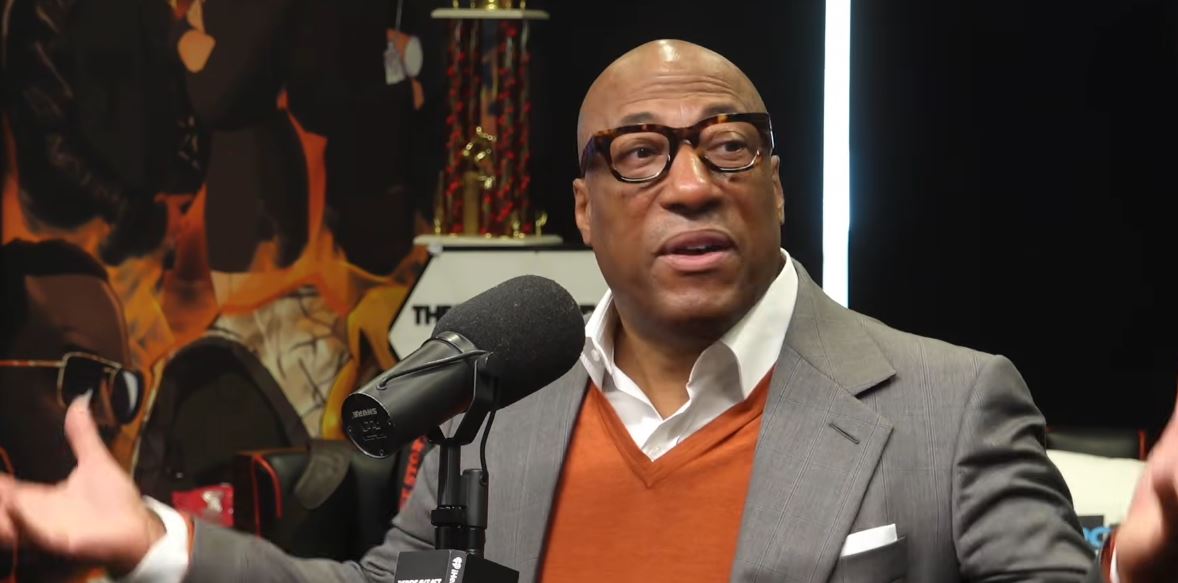
Byron Allen has a low-key quality that seems almost intentional. In the sense that someone who has been undervalued for decades eventually stops correcting people, rather than in the sense that it feels like false modesty. Byron Allen and Jerry Seinfeld are at the top of the comedian wealth rankings, with Byron Allen’s net worth estimated by most reliable sources to be around $1 billion. Nevertheless, when discussing media power in America, his name hardly ever comes up as it ought to.
His story is worth listening to in part because of that disconnect. Born in Detroit in 1961, Allen was raised in Los Angeles, where his mother was employed by NBC as a publicist. He used to wander the studio lots as a child, sneaking onto the set of “The Tonight Show” and sitting behind Johnny Carson’s desk. That picture, of a boy pretending to be in charge before anyone would allow him to do so, has a telling quality. He started writing jokes at the age of 14. He was reportedly the youngest stand-up comedian to ever perform on “The Tonight Show” when he was eighteen.
Opportunities quickly opened up after that debut. During those years, he co-hosted the popular NBC series “Real People,” and he did something that most performers his age didn’t do: watch. He observed how content was disseminated, how advertising was purchased and sold, and who was truly profitable. Perhaps more significant than any joke he ever wrote was this compulsive study of the business machinery.
Allen established Entertainment Studios, a production company based on a unique model, in 1993. He provided the content for free instead of charging networks for his shows. In return, he sold each program’s advertising time directly to advertisers, keeping half of it. It seems paradoxical until you consider that he was able to undercut rivals on ad pricing while maintaining scale by reaching 35 million viewers across dozens of programs. His businesses now create more than 30 nationally syndicated shows, bringing in over $100 million a year.
The model’s early years were difficult. Allen has been candid about dealing with home foreclosures and working from a payphone in the past. This story can be framed as an underdog story in one version, but it might be too straightforward. It had less to do with adversity and more to do with obstinacy—a refusal to give up on a business model he supported before the market caught up.
The Weather Channel television network was purchased by Allen in 2018 for $300 million, a decision that caused controversy at the time. His larger business, Allen Media Group, was worth more than $4.5 billion by 2022. In addition, he owns a portfolio of broadcast television stations and twelve cable networks. He owns properties in Malibu, Beverly Hills, Maui, Aspen, Los Angeles, and New York, including a mansion in Malibu that he allegedly paid $100 million for.
Even in cases where his acquisition attempts failed, they have been more difficult to overlook. Tegna, the Washington Commanders, ABC and associated Disney properties, BET from Paramount, and, most ambitiously, a $14 billion offer for Paramount itself in early 2024 are among the bids he has made. None of those agreements were completed. It’s still unclear if these initiatives represent a pattern of ambitious overreach or an aggressive but disciplined growth strategy. In any case, the bids indicate where Allen believes the media will go and how big he plans to be within it.
It is more difficult to distinguish the legal aspect of his career from the business aspect. In 2021, he filed a $10 billion lawsuit accusing McDonald’s of purposefully underfunding Black-owned media advertising. In 2025, McDonald’s agreed to buy advertising from Allen’s properties at market value as part of an out-of-court settlement. Although the specifics were not made public, Allen’s subsequent remarks in public indicated that he thought it was a significant result. In 2021, a private settlement that included carriage agreements for three of his cable channels put an end to his previous legal battle with Comcast, which had reached the Supreme Court.
Allen announced in May 2026 that he would pay $120 million to take over as chairman and CEO of BuzzFeed. It’s unclear if that wager will be profitable, but Allen’s history indicates that he almost never walks into a room without first looking at the exits.
Depending on who you ask, Byron Allen’s $1 billion net worth is either a floor or a modest estimate. According to Forbes, the figure might be higher. It’s undeniable that he started this from nearly nothing, used a distribution strategy that the majority of the industry rejected, engaged in legal disputes that went all the way to the nation’s highest court, and accomplished all of this with a nearly noticeable lack of celebrity fanfare. Perhaps more than any monetary amount, that is the aspect that needs to be taken into consideration.
