



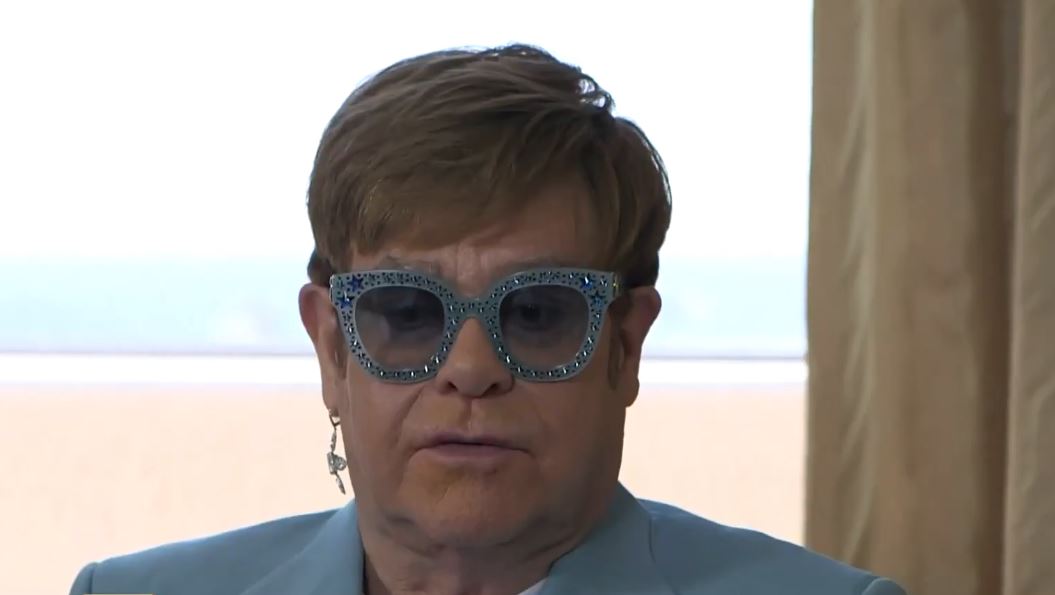
Within hours of the tickets going on sale, the arena in Allentown, Pennsylvania was completely sold out when Elton John took the stage in September 2018. It should have been clear from that detail alone what was about to happen. However, it’s unlikely that even the most optimistic forecasts at the time mentioned “nearly a billion dollars.”
The Farewell Yellow Brick Road Tour attracted 6.1 million fans from North America, Europe, and Oceania and made $939.1 million from 330 shows by the time the curtain fell in Stockholm on July 8, 2023. It became the first tour in history to surpass both the $800 million and $900 million milestones and the third-highest-grossing tour ever. Neither had ever been done by a tour before.
Those figures contain something worthwhile. Elton John made this announcement out of a sincere desire to be at home with his two sons and husband, David Furnish, rather than out of diminishing relevance. By most accounts, it was a sincere explanation. And for some reason, that candor resulted in one of the most lucrative touring runs in recorded music history.
With $567.7 million from 183 shows, or about 61% of the total global gross, North America carried the most weight. Australia and New Zealand, which are frequently overlooked in global touring calculations, contributed a meek $134 million, while Europe came in second with $218 million. John didn’t try the stadium leg until May 2022, but it made up 36% of total earnings despite only covering roughly 19% of all shows. The tour’s financial trajectory was completely altered by the late-run switch from arenas to stadiums.
It’s easy to forget how modest the initial numbers were. John’s Farewell had only made $217 million when Ed Sheeran’s Divide Tour concluded in 2019 with a then-record $776 million. The two were not being compared. The tour was severely postponed due to the pandemic, and dates were extended due to a hip injury. Even though those delays were annoying, it’s possible that they prolonged the tour’s cultural significance by keeping it in the public eye longer than anticipated.
Although it doesn’t count toward official Boxscore figures, the June 2023 appearance at Glastonbury is its own footnote. The average number of viewers on BBC One was 7.3 million, which is a record for any festival act and more than twice as many as Diana Ross. A British career that started before the majority of the audience was born came to an end when a man wearing pink heart-shaped sunglasses performed for 120,000 people in a field while millions more watched from home. The revenue figures don’t fully convey the weight of that image.
This is part of a larger narrative about the mistakes made by the music industry when discussing legacy artists. It’s common to assume that musicians at a particular age or stage of their careers are coasting, playing hits for nostalgia and appealing to listeners who aren’t purchasing new music anyhow. That image is significantly complicated by Elton John’s farewell tour. The demand was genuine, steady, and worldwide. Within hours of the first 60 shows going on sale, all of the tickets were sold out. It’s not nostalgic economics. That is the endurance of culture.
It’s unclear if retirement tours in the future will follow this model. The genuine emotional weight of a real farewell from a person who has performed for fifty years, the stadium moments, the Glastonbury coda, and the tears when President Biden gave John the National Humanities Medal at the White House in September 2022 are all examples of the unique alchemy that made this one work. Rarely do numbers this size come without a backstory like that.
In the end, Elton John’s Farewell Tour Windfall proved that an exit can be just as defining as any peak if it is handled with integrity and scope. He didn’t simply walk off the road. He left it with a record that could last a very long time.
