



The scenery doesn’t seem to belong in any farming tale you’ve ever read when you stroll through Dubai’s industrial suburbs. logistics centers, warehouses, and the odd construction crane. However, once you enter one of the increasing number of climate-controlled buildings, everything completely changes: there is no soil in sight, roots hanging in nutrient mist, and rows of leafy greens suspended in midair under pink LED lights. It’s a peculiar form of farming. Additionally, it may be precisely what the area—and perhaps the entire world—needs at this moment.
Nearly 90% of the food consumed in the UAE is imported. That figure alone helps to explain why Dubai has chosen to approach food production more like a national infrastructure project rather than as a quiet agricultural issue. The ambitious goal of the UAE National Food Security Strategy 2051 is to transition the nation from almost complete reliance on imports to becoming a significant agricultural producer. The investments being made in that direction are genuine and increasing, though it’s still unclear if that’s entirely possible.
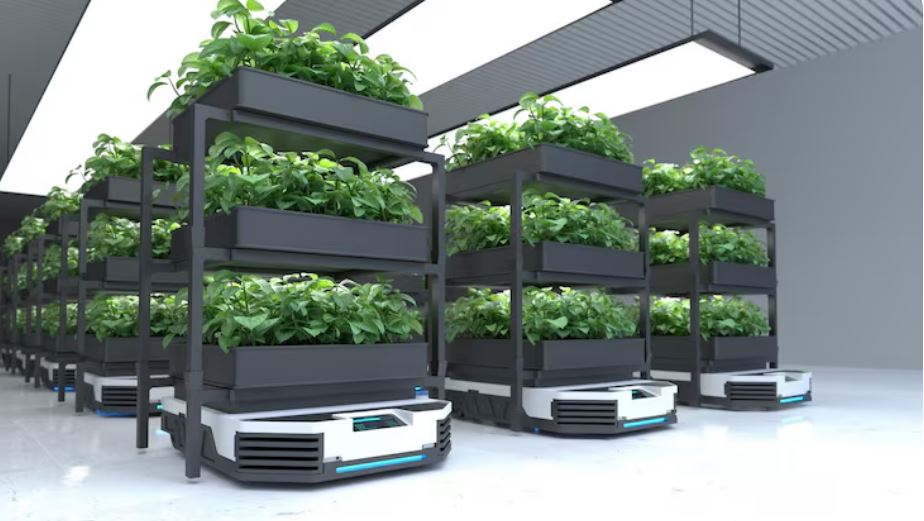
The CEO of Dubai-based agtech startup Krispr, Khadija Hasan, puts it simply. According to her, the objective is to “decouple farming from its traditional variables”—soil, climate, and temperature—and move it indoors, where those factors are completely under control. Plant roots at Krispr’s vertical farm are suspended in the air and given precisely measured amounts of water and nutrients. The ground loses nothing. Weeds don’t waste anything. Efficiency, not acreage, is the foundation of this entirely different farming logic.
The economics of this are still developing. Compared to traditional field agriculture, vertical farming uses a lot less water—some operations report reductions of up to 95%—but there are real electricity costs. Climate control systems, artificial lighting, and continuous surveillance are expensive.
It’s important to acknowledge that the industry hasn’t yet fully resolved the conflict between energy costs and resource savings. According to Sky Kurtz of Pure Harvest Smart Farms, his operation is 20 times more water-efficient and 30 times more productive than field farming. In the middle of the UAE summer, strawberries are grown in greenhouses in Al Ain. The direction those figures indicate is significant even when promotional optimism is taken into consideration.
The degree of institutional support for private endeavors is what makes Dubai’s situation unique. AgriTech loans are available from the Emirates Development Bank to assist creative initiatives. AI-driven analytics are used by a food security dashboard to monitor availability and consumption almost instantly. Local producers and government buyers are connected through the National Farm Sustainability Initiative. The majority of agriculture-focused cities elsewhere haven’t been able to create this kind of network of public-private cooperation, at least not at this rate. The UAE Food and Beverage Manufacturers Group Chairman, Saleh Lootah, has stated unequivocally that the government cannot accomplish this on its own, and Dubai appears to have learned this lesson rather than merely repeating it.
All of this has real global stakes. Food policy researchers are genuinely concerned about the gap between what conventional farming can consistently produce and what humanity will require, given that the world’s population is expected to approach 10 billion by the middle of the century. In areas that have traditionally been dependable exporters, yields are being disrupted by climate change, further narrowing the gap. Due to its vulnerability—sitting at the nexus of intense heat, limited water supplies, and a high reliance on imports—Dubai has taken the issue more seriously than most. Real innovation may result from this urgency, or at the very least, conditions that allow innovation to endure long enough to be significant.
Naturally, indoor vertical farming has its limitations. It works well with some fruits, herbs, and leafy greens. No stack of LED-lit growing towers will ever be able to replace the amounts of cereals, cooking oils, and staple crops that the UAE still imports from Brazil, India, and other countries. The truthful version of this tale combines real progress in one area of the food supply issue with a much more difficult set of issues that are still mostly unresolved.
Nevertheless, this is worthwhile to watch. Dubai’s approach to food differs from that of most cities, where it is handled by markets and logistics networks that operate in the background. It views food production as a design challenge that can be overcome rather than overcome by limitations.
