



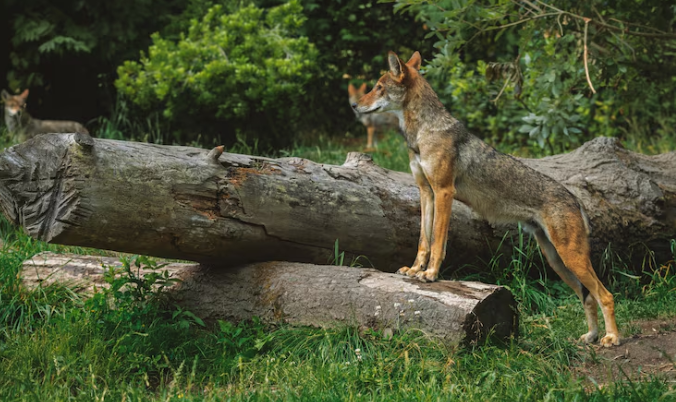
In some Chicago neighborhoods, the streets become eerily quiet late at night. Traffic decreases. The lights in the apartment blink off. Movement resumes somewhere along a railroad line, close to an alley or a patch of uncut grass. A slender animal stops close to an overflowing trash can and slides between parked cars. The shape is visible in the half-light. A coyote, moving through the city at a trot as though it had always been there.
For many years, people believed that cities were the antithesis of wilderness, with asphalt, steel, and glass driving out the natural world. However, the message was never fully understood by the animals. Certain animals, such as coyotes and red foxes, have quietly adapted to live in the same environments that humans created for themselves throughout North America and portions of Europe.
| Category | Details |
|---|---|
| Topic | Urban Wildlife Adaptation |
| Key Species | Coyote, Red Fox |
| Habitat | Urban parks, suburbs, city streets, green corridors |
| Typical Urban Food Sources | Rodents, birds, insects, garbage, pet food |
| Notable Urban Locations | New York City, Chicago, Los Angeles |
| Scientific Field | Urban Ecology |
| Major Challenge | Human–wildlife conflict |
| Ecological Benefit | Rodent control and ecosystem balance |
| Reference Organization | National Wildlife Federation |
| Reference Website | https://www.nwf.org |
The term “adaptation” is used by urban wildlife researchers, but it sounds almost too formal for the situation. In settings that would have seemed ridiculous to their ancestors—highways roaring overhead, delivery trucks rumbling through alleys, skyscrapers glowing late into the night—these animals are improvising their lives.
The pattern is now well-known in many cities. The edges—quiet suburbs, rail lines, and industrial areas—are where coyotes first emerge. After that, they travel inward, visiting golf courses and parks. Sightings eventually happen in locations that seemed unlikely at first. A jogger in Central Park glimpses one darting across a path. Security cameras in Los Angeles capture another wandering through a strip mall parking lot at 3 a.m. It’s hard not to notice the strange confidence of these animals.
Part of the explanation is surprisingly simple. Cities produce enormous quantities of food. Rodents thrive in subway tunnels. Garbage spills from restaurant dumpsters. Backyard gardens attract rabbits and birds. For an adaptable predator like the coyote, the modern city sometimes resembles an all-night buffet.
Foxes have taken a slightly different route, but the results look similar. The red fox—smaller, quieter, almost delicate compared with the coyote—has become a familiar figure in many European neighborhoods. Residents in London sometimes report spotting them trotting across quiet streets at dawn, tails brushing against the pavement like a rust-colored shadow.
Watching these animals navigate traffic and streetlights raises a deeper question. Are cities becoming ecosystems in their own right?
It’s possible that urban landscapes, messy as they appear, provide exactly what certain species need. green areas in patches. plenty of prey. fewer big predators. Tall structures can also serve as habitats. Peregrine falcons, once nearly wiped out, now nest on skyscrapers that mimic the cliffs they historically used. Some people find the idea unsettling.
When wildlife appears in human neighborhoods, fear is still the most likely response. A coyote seen near a school playground can spark alarm, sometimes exaggerated. Yet statistics suggest something quieter: attacks are rare, and many urban predators prefer avoiding humans altogether. Instead they adjust their schedules.
Coyotes that live in cities often become almost entirely nocturnal, moving through streets while people sleep. Studies tracking GPS-collared animals have shown them slipping through narrow corridors—rail lines, drainage canals, highway medians—using these accidental pathways as if they were forest trails. It’s still unclear whether these behaviors are temporary improvisations or the beginning of something deeper.
Urban environments exert strange pressures on wildlife. Birds are forced to sing at higher pitches due to noise. Normal hunting patterns are disturbed by artificial light. Human routines cause food sources to change. These forces may eventually influence not only behavior but also evolution.
Subtle biological changes are already suspected by some scientists. Animals are becoming more daring. The brain adjusts to complicated surroundings. Maybe even genetic changes that favor people who can deal with human unpredictability, noise, and traffic.
Cities seem to be turning into natural selection labs. The relationship is still tense, though. Small animals are a concern for pet owners. The removal or relocation of predators is a topic of discussion among municipal officials. Every sighting is magnified by social media, transforming fleeting interactions into widely shared headlines.
The tension feels strangely familiar as I watch this play out. Humans spread outward for centuries, changing plains, rivers, and forests. The wildlife is now creeping back in, negotiating a new arrangement rather than precisely reclaiming the land.
Coexistence can occasionally lead to quiet moments of wonder. At dawn, a fox crosses a snowy sidewalk. A coyote listening to far-off sirens reverberate through buildings while standing at the edge of a city park.
The experience can seem almost surreal to those who were raised to believe that nature only existed in far-off mountains or national parks. It’s difficult to ignore the fact that cities are evolving.
Of course, concrete is still present everywhere. Glass towers continue to rise. There is still a lot of traffic. Beneath that familiar exterior, however, a different world is emerging, one that moves primarily at night, sneaking through dimly lit parks and alleys.
Additionally, it appears that coyotes have already discovered something that humans are only now starting to comprehend. We never had complete control over the concrete jungle.
